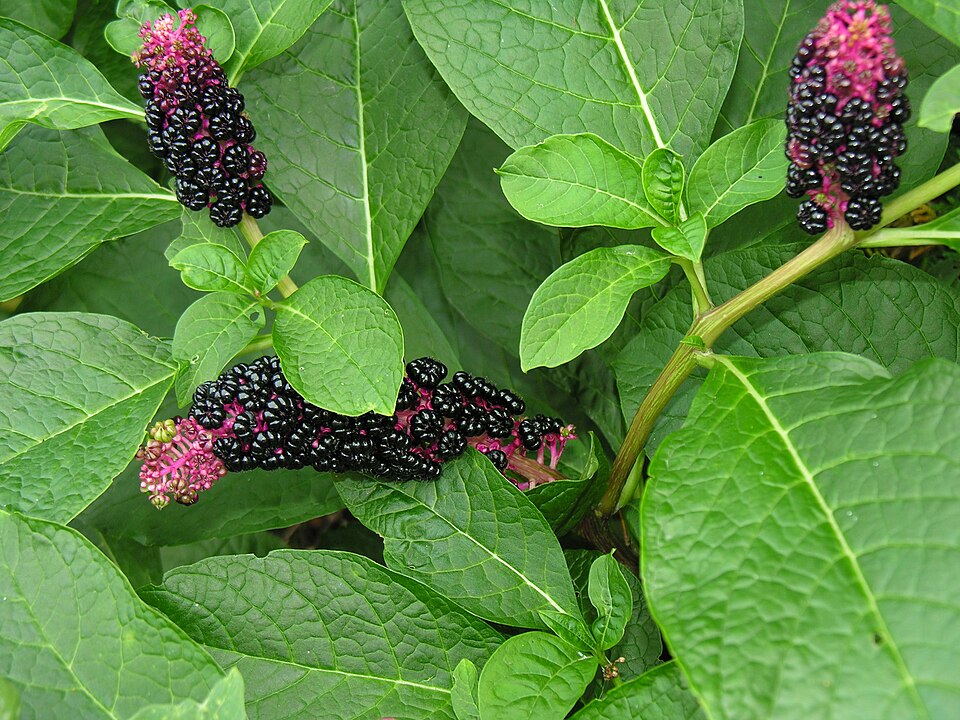

Phytolacca acinosa
Indian pokeweed
Accumulation profile
- Substrate
- Manganese-rich and mine soils
- Habitat
- Disturbed ground and mine areas
- Distribution
- East Asia
- First reported
- 2004 · Xue et al.
- Verification
- primary-measured
Description & ecology
A high-biomass herb evaluated for manganese phytoextraction around Chinese manganese mines.
Promoted to primary-measured 2026-11-08: Xue, Chen, Reeves, Baker, Lin & Fernando 2004 (Environmental Pollution 131(3):393–399, doi:10.1016/j.envpol.2004.03.011, abstract read at source via PubMed, independently cross-confirmed by two vendor re-reads): maximum leaf Mn 19,300 µg g⁻¹ dry matter (mean 14,480) on the Xiangtan Mn mine-tailings wasteland, with glasshouse confirmation of the hyperaccumulator trait. Caveat: the field maximum comes from an anthropogenic Mn-tailings substrate; the same paper's hydroponic leaf maximum (36,380 µg g⁻¹ at 12,000 µmol Mn L⁻¹) is dosed and is noted here, never substituted for the field value.
References
- Xue, S. G., Chen, Y. X., Reeves, R. D., Baker, A. J. M., Lin, Q. & Fernando, D. R. (2004). Manganese uptake and accumulation by the hyperaccumulator plant Phytolacca acinosa Roxb. (Phytolaccaceae). Environmental Pollution, 131, 393–399. doi:10.1016/j.envpol.2004.03.011
- Reeves, R. D., Baker, A. J. M., Jaffré, T., Erskine, P. D., Echevarria, G., & van der Ent, A. (2018). A global database for plants that hyperaccumulate metal and metalloid trace elements. New Phytologist, 218, 407–411. doi:10.1111/nph.14907